A Practical, Experience-Driven Guide
Street lighting projects often fail not because of poor luminaires, but because decision-makers choose the wrong configurations at the control panel level. The control panel acts as the brain of the entire street lighting system. It determines how reliably lights operate, how safely power is distributed, and how transparently the system can be monitored.
This guide helps you select the right street light control panel especially if you are a contractor, consultant, or government official who wants to make an informed, long-term decision rather than a price-driven one.
We designed this guide with a simple intent: to educate first, so you can make decisions with clarity and confidence.
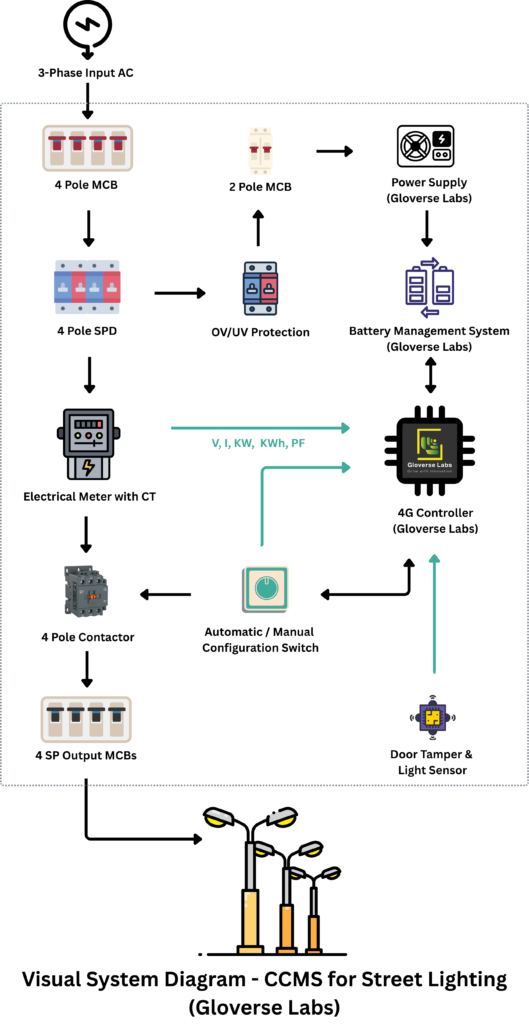
Step 1: Decide the Power Configuration
Single Phase or Three Phase Panel
The first decision is the type of electrical supply available and required.
Use a single-phase panel for very small installations with limited load. In contrast, choose a three-phase panel to handle higher loads, ensure better voltage stability, and support large street lighting networks.
In India, municipalities and government contracts use three-phase panels in more than 90% of street lighting projects. These panels provide scalability and align better with future expansion.
Step 2: Decide the Control Architecture
Group Control or Individual Light Control
Next, decide how you will control the lights.
Group control connects multiple street lights to a single control panel and operates them together. This approach keeps the system simple, cost-effective, and widely used across India.
Individual light control lets you manage each street light separately. While this method offers greater control, it requires additional infrastructure and higher investment.
For most tenders and real-world projects, group control remains the most practical and accepted approach.
Step 3: Decide How the Lights Will Operate
After you decide the panel structure, choose the operating logic.
Timer-Based Operation
A timer switches lights ON and OFF at fixed times. While simple, it requires frequent seasonal adjustments due to changing daylight hours and is prone to manual errors.
Sensor-Based Operation (Photo Sensor)
Photo sensors detect ambient light and operate the lights accordingly. This removes the need for seasonal adjustments but can sometimes result in false operation due to dust, fog, shadows, or environmental disturbances.
Astronomical Timer
An astronomical timer uses the geographical location (latitude and longitude) to calculate sunrise and sunset automatically. It provides accurate operation without relying on external sensors or manual adjustments.
CCMS (Centralized Control & Monitoring System)
CCMS is an advanced system that allows remote control and monitoring of street lighting panels.
With CCMS, you can:
- Operate lights based on schedules or sunrise/sunset logic
- Monitor electrical parameters such as voltage, current, and energy consumption
- Detect whether any light is OFF or how many lights are not working
- Identify abnormalities that may indicate power theft or unauthorized usage
- Access all this information remotely, without physical site visits
CCMS significantly improves transparency, accountability, and operational efficiency.
Step 4: Calculate Load and Panel Rating
Determine the panel rating based on the total connected load.
For example:
- 100 street lights
- Each light rated at 150 W
Total load = 100 × 150 = 15,000 W (15 kW)
Select a panel rated at 15 kW accordingly. Common ratings include 5 kW, 7 kW, 10 kW, 15 kW, and higher, depending on project size.
Step 5: Essential Protection and Switching Components
Miniature Circuit Breakers (MCBs)
MCBs protect the system against overloads and short circuits. They are essential for safety and fault isolation.
At the input side, MCBs protect the entire panel and internal wiring. For three-phase systems, a 4-pole MCB (R-Y-B-N) is useful as it ensures complete isolation, including the neutral, which is critical for safety during maintenance.
At the output side, individual MCBs protect lighting circuits so that a fault in one section does not affect the entire system.
Contactors
Contactors act as electrically operated switches that control high-current loads. In street light panels, they are responsible for switching the lighting circuits ON and OFF. They are robust, widely used, and suitable for frequent switching operations.
Latching Relays
Latching relays change their state using a short electrical pulse and remain in that position without continuous power. Use them in modern control logic when you need low power consumption, reduced heat generation, and long operational life.
Step 6: Energy Measurement
Energy Meter
Use an energy meter to measure electrical consumption and parameters such as voltage and current. It plays a key role in:
- Energy auditing
- Performance analysis
- Billing validation
- Detecting abnormal consumption patterns
In higher load panels, use Current Transformers (CTs) along with the energy meter. CTs safely scale down high current values, allowing accurate measurement without direct exposure to high currents.
Step 7: Protection Devices for Outdoor Reliability
Surge Protection Device (SPD)
Lightning and grid disturbances expose street light panels to electrical stress. An SPD protects sensitive electronics and control equipment from transient voltage surges. Lack of proper surge protection is one of the most common reasons for electronic failures in outdoor installations.
Over-Voltage and Under-Voltage Protection
These protection devices disconnect the load when voltage goes beyond safe operating limits. This prevents damage to LED drivers, improves system reliability, and extends the life of lighting assets.
Step 8: Additional Components Used in CCMS Panels
Door Switch
A door switch detects when someone opens the panel door. This helps in identifying unauthorized access and improves accountability, especially in public installations.
Power Module
The power module converts incoming AC power to stable DC power required by the controller and communication devices.
Battery Module
The battery ensures the controller remains operational during power outages, enabling event logging and communication.
Battery Management System (BMS)
The BMS protects the battery from overcharging, deep discharge, and unsafe operating conditions, ensuring long battery life and safety.
Photo Sensor (as Redundancy)
Use photo sensors as backup logic in critical applications. During extreme weather conditions such as heavy clouds, storms, or network issues, they provide an additional layer of operational reliability.
Panel Enclosure Selection
The panel enclosure must withstand outdoor conditions.
- Metal / CRCA enclosures offer strength but are costlier and require proper corrosion protection.
- Fiber / PVC / SMC enclosures are lightweight, corrosion-resistant, weatherproof, and widely preferred for modern outdoor installations.
Frequently Asked Questions
What is the difference between a timer and CCMS for street lighting?
A timer switches lights at fixed times. CCMS adds remote monitoring, energy tracking and fault detection on top of scheduled operation.
What panel rating do I need for 100 street lights at 150W each?
Total load is 15kW. For a 3-phase 15 kW panel, the minimum recommended ratings are a 40A, 4-pole MCB and a 50A, 4-pole contactor.
Is a 3-phase panel required for municipal projects in India?
Yes. Most municipal and government tenders in India specify 3-phase panels for stability, load balancing and future scalability.
A Note from Gloverse
This guide is not theoretical.
We have prepared it based on our hands-on experience of working on numerous smart street lighting projects across India, covering urban, semi-urban, and rural environments. Over time, we have seen what works reliably in the field and what fails. We believe that sharing this knowledge openly helps projects succeed and raises the overall quality of street lighting infrastructure.
Gloverse Labs designs and manufactures CCMS street light control panels in India. If you are working on a tender or project, discuss your requirement with our team.
Gloverse Labs designs and manufactures smart street lighting systems in India. ISO 9001:2015 certified. MeitY supported.
See our CCMS panel Talk to our team